The use of machinery and tools in the workplace creates several risks. When Health & Safety procedures aren’t followed, the likelihood of injury, ill health, and even death increases.
To ensure compliance and the wellbeing of staff and the public, Peninsula has been providing expert
Health & Safety services for over 40 years.
A condition that can arise from prolonged exposure to certain vibrating machinery is hand-arm vibration syndrome (often abbreviated as HAVS).
But what is hand-arm vibration? And how can it be prevented? Our guide provides an overview of this occupational disease.
Hand-arm vibration syndrome: An overview
Workers whose duties involve repetitive use of vibrating hand-held tools are susceptible to suffering from HAVS. This results in damage to nerves, blood vessels and muscles—all of which are permanent.
What legislation covers hand-arm vibration syndrome?
Under the Control of Vibration at Work Regulations 2005, employers have a legal obligation to protect their workers from health risks resulting from mechanical vibration—with one of those being HAVS.
What does a hand-arm vibration assessment involve?
As part of HAVS regulations, employers, and the self-employed, must conduct a HAVS assessment. The assessment should do the following:
- Identify where vibration could cause a risk and who is likely to be impacted by it
- Include a reasonable estimate of their employees’ exposure
- Establish measures needed to be taken to meet Health & Safety laws
- Ascertain which workers may need to be given health surveillance
What are examples of hand-arm vibration symptoms?
As discussed, it’s long-term exposure that leads to HAVS symptoms—they’re rarely immediate.
This is often part of the problem with HAVS monitoring. Many wrongly assume that because they’re not experiencing symptoms straight away, that they’re safe from HAVS.
However, HAVS symptoms typically become apparent after just a few months of exposure. For others, it could take years.
Those with continued exposure to vibration are likely to experience heightened HAVS symptoms, including:
- Tingling sensation and numbness in the fingers
- An inability to feel things properly
- Reduced grip strength
What is vibration white finger (VWF)?
Long-term, regular exposure to hand-arm vibration (HAV) leads to potentially permanent and debilitating health effects, such as vibration white finger and carpal tunnel syndrome, generally known has HAVS.
What does hand-arm vibration syndrome cause?
HAVS affects the nerves, blood vessels, muscles and joints of the hand, wrist and arm. All of which can become severely disabling if ignored.
How does carpal syndrome impact someone?
Carpal tunnel syndrome is a disorder of the nerves in the wrist that may involve pain, tingling, numbness, and weakness of the hand or wrist. However, these symptoms can occur naturally through exposure to vibration, which is known as a causal factor.
What are the signs of vibration white finger?
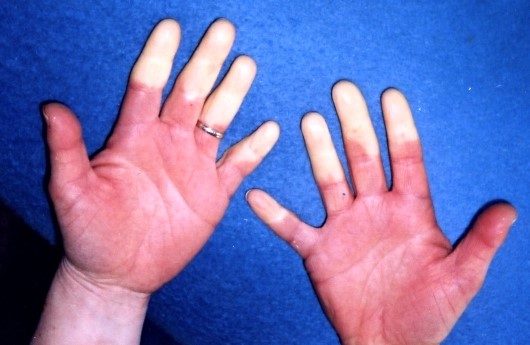
Symptoms of VWF include tingling, numbness, unable to feel through fingers, and loss of strength in the hands. In the cold and wet fingers will turn white and then red accompanied by pain when recovering.
What is Raynaud’s phenomenon?
In more severe cases, HAVS can cause Raynaud’s phenomenon. This is when cold conditions cause blood vessels to narrow. A Raynaud’s attack usually causes skin colour changes:
- White: Restricted blood flow, resulting in the skin becoming pale
- Blue: As tissues use up remaining oxygen, the area changes to blue or purple
- Red: When the blood flow returns, skin becomes bright red and swells
Larson Davis
How can hand-arm vibration syndrome impact people?
There are several consequences resulting from HAVS, all of which could be permanent. Here are some examples:
- Pain and disruption to sleep
- Struggling to complete everyday tasks like buttoning a shirt
- Fine work (assembling small components) becomes difficult
- Working in cold conditions causes discomfort to impacted areas
What causes hand-arm vibration syndrome?
Frequent use of heavy machinery and power tools are the prime reason for people suffering from HAVS. Examples include:
- Concrete breakers
- Angle grinders
- Chain saws
Essentially, any person using power tools that grind, cut, saw, or drill, have the potential to develop HAVS symptoms.
Industries where this is prevalent, such as
agriculture or
construction, will be at an elevated risk.
How can the effects of hand-arm vibration be reduced?
Symptoms and effects can be mitigated by implementing HAVS exposure limits:
- Find alternatives: Firstly, where possible, employers and workers should work together to find alternative methods that remove the need for vibrating tools.
- Maintenance: Where an alternative isn’t available, tools should be properly maintained to ensure they’re working correctly and safely—PUWER regulations can help with this.
- HAVS training: Improper tool use can cause HAVS symptoms. Employers should provide comprehensive Health & Safety training.
- Reporting: Employers must encourage their staff to report early HAVS symptoms—this is paramount, as this disease is preventable.
FAQs: What is hand-arm vibration syndrome (HAVS)?
What are employers’ main legal duties?
Employers are required to conduct a HAVS assessment, implement measures to reduce exposure, provide HAVS training and health surveillance, and keep records of risk assessments.
How do employers know if there’s a vibration problem?
Typically, if hammer action tools are used for more than 15 minutes per day, or if rotary tools are used for more than an hour; action should be taken.
What are the specific exposure limits?
Vibration, measured using an accelerometer, is the average magnitude of the vibration produced by the tool in metres per second squared (m/s2). The damage caused by vibration relates to a worker’s total exposure over an 8-hour working day. This ‘daily vibration exposure’ considers the vibration magnitudes to which the worker is exposed, and the time they’re exposed.
Currently the maximum exposure limit value (the ELV) for vibration is set at 5 m/s2 over an eight-hour working period. The exposure action level (the EAL) is set at 2.5 m/s2. If daily exposure is greater than the action level of 2.5 m/s2 employers must take action to reduce the risk to the worker.
Should employers buy expensive hand-arm vibration monitoring equipment?
Legally, employers are not required to buy HAVS monitoring equipment. However, they must carry out a proper risk assessment.
When must employers report hand-arm vibration syndrome?
As per
RIDDOR, employers must report all cases of HAVS if they’re work-related.
Final say: What is hand-arm vibration syndrome (HAVS)?
Frequent use of vibrating tools has the potential to cause HAVS, which is often permanent and disabling.
Importantly, this occupational disease is preventable. Therefore, it’s imperative that employers adhere to HAVS regulations.
Do you need help mitigating hand-arm vibration syndrome?
Damage can be permanent, but early protection through health surveillance can help prevent the condition impeding your workers’ quality of life.
HAVS claims will only ever be detrimental to your business. Peninsula supports you in following HAVS regulations, meaning your staff and reputation are protected.
Partnering with Peninsula transcends just support for HAVS. You’ll get:
Over 40,000 UK businesses trust us to help them meet their Health & Safety obligations.
Contact us today to find out why.


 Guide
Guide Peninsula GroupHR and Health & Safety Experts
 Guide
Guide Guide
Guide