In this guide, we'll discuss working in confined spaces, confined spaces regulations, and safe systems of work.
Loading content...
What is Confined Space Work?
FAQs
Got a question? Check whether we’ve already answered it for you…
HR management outsourcing is when a team of experts manage your HR by looking after your contracts, policies, and procedures.
These are the HR essentials every business needs. Without them, your staff could bring successful claims against you, you could lose thousands in legal fines, and even face prosecution. Never underestimate the benefits of HR support for a small business.
We have years of experience in providing HR for SMEs and HR management outsourcing. Contact us to see how we can support you, including HR advice for small businesses - as well as medium and large companies.
Good human resource management is having round the clock support when you need it the most.
Whenever there’s a staff challenge or an important legal update, you just pick up the phone and get the help you need – no matter the time or place.
The main benefits of HR outsourcing are:
- Cost saving: Reduces the expenses for such things are hiring, training and employing an in-house HR team.
- Time saving: Saves time for staff members away from HR tasks.
- Improves expertise and compliance: Provides ongoing advice and support to ensure complete and total compliance.
- Reduces risk: Reduces the risk of any payroll and compliance failures.
Outsourcing HR is cheaper than hiring internal staff and saves you money overall when it comes to your HR service. Plus, you avoid making mistakes that could cost you heavily in claims and legal fines down the line. Every business should consider HR support as a way to avoid claims.
Peninsula is one of the leading HR outsourcing services in the UK, and by working with us you get access to our HR advisory service. Contact us for your outsourced SME HR today.
The key functions of HR outsourcing services are:
- Payroll and benefits: Helps a business to manage employee wages, tax processing, and employee enrolment.
- Recruitment and onboarding: Helps with job descriptions, sourcing new candidates, interviewing, and ensuring a smooth onboarding process.
- Compliance with employment law: Helps to ensure compliance with ever-changing employment legislation.
- Employee relations: Helps to manage grievance and disciplinary procedures, and any ongoing support that's required.
- HR admin: Helps to handle and manage daily tasks, such as employee records, sorting employment contracts, and processing any leave requests.
- Training and development: Helps to create and deliver staff training programs to improve employees' skills.
Since its nation-wide ban in 2007, smoking quickly became an unpopular lifestyle choice for many people. However, in recent times, the popular rise in vapes and e-cigarettes have encouraged factors
In this guide, we'll look at how to work on a roof safely, what the law covers, and how to minimise the risks of working at heights.
Peninsula GroupHR and Health & Safety Experts
Safe Working Practices
Created by experts, powered by
HR and H&S advice to the next level!
Our enhanced AI solution...
Jump to section:
No workplace is without hazards and risks. Especially if your staff work in confined spaces regularly. If you must conduct work in one, you need to follow confined space regulations. Otherwise, your business could suffer severe consequences.
Failure to carry out a risk assessment - or follow other legal duties - could result in the serious injury of an employee. Consequently, your company might face legal proceedings, employment tribunal claims, and even business closure.
In this guide, we'll discuss working in confined spaces, confined spaces regulations, and safe systems of work.
What is a confined space?
A confined space is an area that's enclosed or largely enclosed. For the law to consider it a confined space, it must present a reasonably foreseeable risk to workers. Such as not having enough oxygen, exposure to hazardous substances, or a lack of fire safety.
A confined space could be something small and restrictive, such as sewers. Or, it might be an area with a large cubic metre capacity, such as a grain storage silo. Whilst both spaces differ in size, they each present certain risks.
What is the current legislation for working in confined spaces?
The Confined Spaces Regulations (1997) is the legislation that advises on working in a confined space. It highlights the key duties businesses must comply with when conducting this type of work.
The legislation states that employers must:
Avoid carrying out tasks in confined spaces. For example, avoid entry and commence work activity outside instead.
Conduct a . This will highlight the present risks of the confined space, and any other dangers you should be aware of. Download our today for you to use when required.
If entry is unavoidable, ensure work carried out follows safe systems. For instance, having ongoing communications with those working in confined spaces via radio.
Implement emergency arrangements in case of emergency situations. For example, appointing a person in charge of calling emergency services if an accident occurs.
Following the above will ensure any work you perform in confined spaces is done in a lawful, safe manner.
Do you have to be trained to work in confined spaces?
Yes, employees working in a confined space must undertake relevant . This ensures they are able to perform the work safely.
Confined space training might:
Discuss what makes a confined space dangerous.
Detail what to consider when conducting risk assessments.
Raise awareness of workplace legal responsibilities.
Outline emergency procedures.
Employees working in a confined space should be a competent person, trained in both the work and use of emergency equipment.
What documents do you need to work in confined spaces?
If your risk assessment reveals that the confined space is high-risk - under UK law - you will need to carry out a permit-to-work. Permits-to-work is a documented procedure that sets out requirements for you to continue working safely.
It also authorises specific employees to carry out specific work in a specific time frame. This includes an outline of what work will be done, and how you plan to conduct it. It's essential in any high-risk work, because it provides a documented trail of the considerations you make in regard to hazards.
You cannot follow a generic document when writing permits-to-work, as they are designed for specific use only. Permits-to-work are highly-detailed to establish Health & Safety compliance. So ensure those performing them manage them carefully.
Get free Health & Safety advice
Discuss your current Health & Safety concerns with a qualified adviser - for free.
What are the specified risks of working in a confined space?
The Confined Spaces Regulations (1997) outline several specific risks of working in a confined space. You should ensure yourself and your employees are aware of them all. So you know how to mitigate or remove them.
Let's explore these specified risks in more detail.
Fire or explosions
Fire or explosions present significant risks when working in a confined space. This is typically because of a build up of liquids, gases and other substances. Similarly, using hot power tools or machinery increases fire risk because of the sparks they produce.
Loss of consciousness from increased body temperature
Another risk of working in a confined space is extreme heat because of inadequate ventilation. The use of heavy and construction work only worsens this. This can result in the collapse - or even heat stroke - of your employees.
Noxious fumes and reduced oxygen levels
Employees may also lose consciousness if exposed to dangerous substances and gases in excess. For example, noxious fumes such as ammonia or chlorine. This can pose a threat as gases flooding in can reduce oxygen levels. Consequently, workers might be unable to breathe properly.
Drowning from liquid level increase
Excess water is another specified risk of working in confined spaces. Due to the little to no drainage, enclosed spaces fill up with water quicker. Meaning, floods can occur rapidly and prevent workers from finding a safe exit. This could put workers in danger of drowning.
Asphyxiation
Asphyxiation is another risk associated with working in a confined space. A build up of dust, grain, or any other contaminant can mean workers struggle to breathe. Even if water gets into a closed compartment (causing rusting), it could result in a depletion of oxygen levels. Subsequently, staff may asphyxiate.
How to prevent injury whilst working in a confined space
Now you're aware of the risks a confined space can present, you should follow a safe system of work. This includes several factors, and each one is equally necessary to ensure compliance with Health & Safety laws.
We've outlined our brief guide to working in a confined space below:
Conduct risk assessments
The first step to take when working in confined spaces is to conduct a risk assessment. A risk assessment will help ensure safe entry into the enclosed space. Moreover, it will outline what hazards the enclosed space presents - and the risks these pose.
For example, performing one might reveal that the valves cannot be locked shut. Which means you run the risk of workers being exposed to hazardous substances.
For more guidance on how to conduct a risk assessment, visit the Health & Safety at Work Regulations website. Or, take a look at our guide.
Provide breathing apparatus
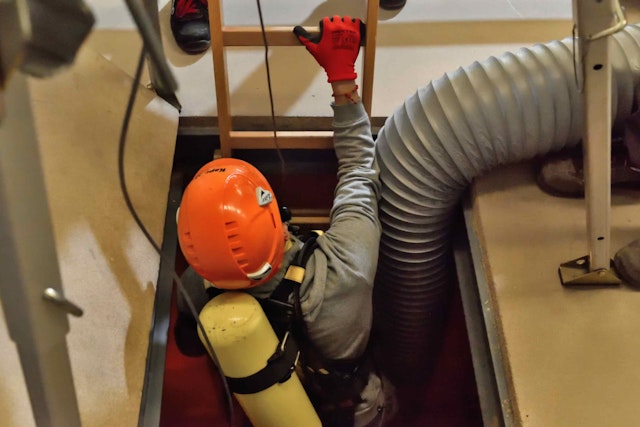
You should also ensure you provide your staff with appropriate personal protective equipment (PPE). This includes any breathing apparatus which will help employees breathe properly.
Protective gear might also include:
Gloves to avoid burns.
A helmet if operating in unsteady construction.
A face mask to increase oxygen levels.
The law requires you to provide PPE when undertaking high-risk work. And that any PPE you supply must be at the expense of your business.
Enforce training requirements
To prevent injury in confined spaces, you should lay out what training you expect from employees. Emphasise that it's a requirement and necessary to any work you perform in confined spaces.
You could ask employees to complete an online course, or bring in a competent person to provide the training. Either are lawful, but in-person training might be more effective, as employees can practice first hand.
Make emergency arrangements
You should also ensure you make emergency arrangements for employees when they work in a confined space.
This includes having a staff member trained in first aid. And having rescue equipment stored in a safe, nearby location, which you can easily access in case of emergency.
Get expert advice on working in confined spaces from Peninsula
Ensure you follow the approved code of practice when working in confined spaces. This includes providing PPE and training, assessing the risks of a confined space, and implementing safe systems.
This will ensure the Health & Safety of your employees, and prevent serious injury from occurring. If you don't manage to work in a confined space lawfully, you could risk legal trouble, hefty fines, and damage to your business's reputation.
Peninsula offers expert advice on working in confined spaces. Our teams provide 24/7 Health & Safety advice which is available 365 days a year. We take care of everything when you work with our experts.
Want to find out more? Contact us on 0800 028 2420 and book a free consultation with a Health & Safety consultant.
Ask a question on Brainbox
Get instant, expert answers to all your HR and health & safety questions


 Guide
Guide Peninsula GroupHR and Health & Safety Experts
 Guide
Guide Guide
Guide